What is the Literacy Crisis?
Written by Trevin Morley
If you have spent any time perusing social media in the last year, you may have heard the term “literacy crisis.” You may have seen this term as educators take to TikTok to voice their grievances about their students being unable to follow directions, or video essayists on YouTube claiming that “Gen Alpha can’t read.” They all make the same claim; that the United States is in a literacy crisis. So, what does it mean to be in a literacy crisis? First, we must understand what literacy is.
Simply put, literacy can be defined as the ability to read and write. However, it is also the ability to understand and interpret what one is reading, writing, and speaking. The literacy crisis does not refer to complete illiteracy, but instead, a lack of proficiency in literacy. Within the conversations of the literacy crisis, another term as gained popularity; “functional illiteracy.” Functional illiteracy is when someone can read and write but is unable to effectively use those skills in everyday life (Williams). Those who are functionally illiterate may be able to read the words on a piece of paper in front of them, but they will not be able to decipher the proper meaning of what they have just read. For example, in relation to everyday life, someone who is functionally illiterate may be able to read political policies on a ballot, but they won’t be able to completely understand them, thus they will have trouble knowing what or who will be most beneficial to them when voting. This effectively sums up many of the problems that define the literacy crisis; people can still read perse, but they cannot use critical thinking skills when doing so. Therefore, when we see the educators or YouTubers talk about the literacy crisis, they are not talking about complete illiteracy, but functional illiteracy.
The literacy crisis is not just an idea tossed around by individuals in conversation and on social media, there is empirical evidence that confirms that America is in a literacy crisis. According to the National Assessment of Educational Progress (NAEP), also known as The Nation’s Report Card, for grades 4, 8, and 12, reading scores have declined since 2019 for every student below the 90th percentile. From 1992 to 2017, reading scores were relatively stable, then in 2019, something shifted, and reading scores began a consistent fall. According to data from the NAEP, “In 2024, the average reading score for the nation at grade 4 was 2 points lower compared to 2022, and 5 points lower compared to 2019” (NAEP). These statistics are the same for grade 8 as well.
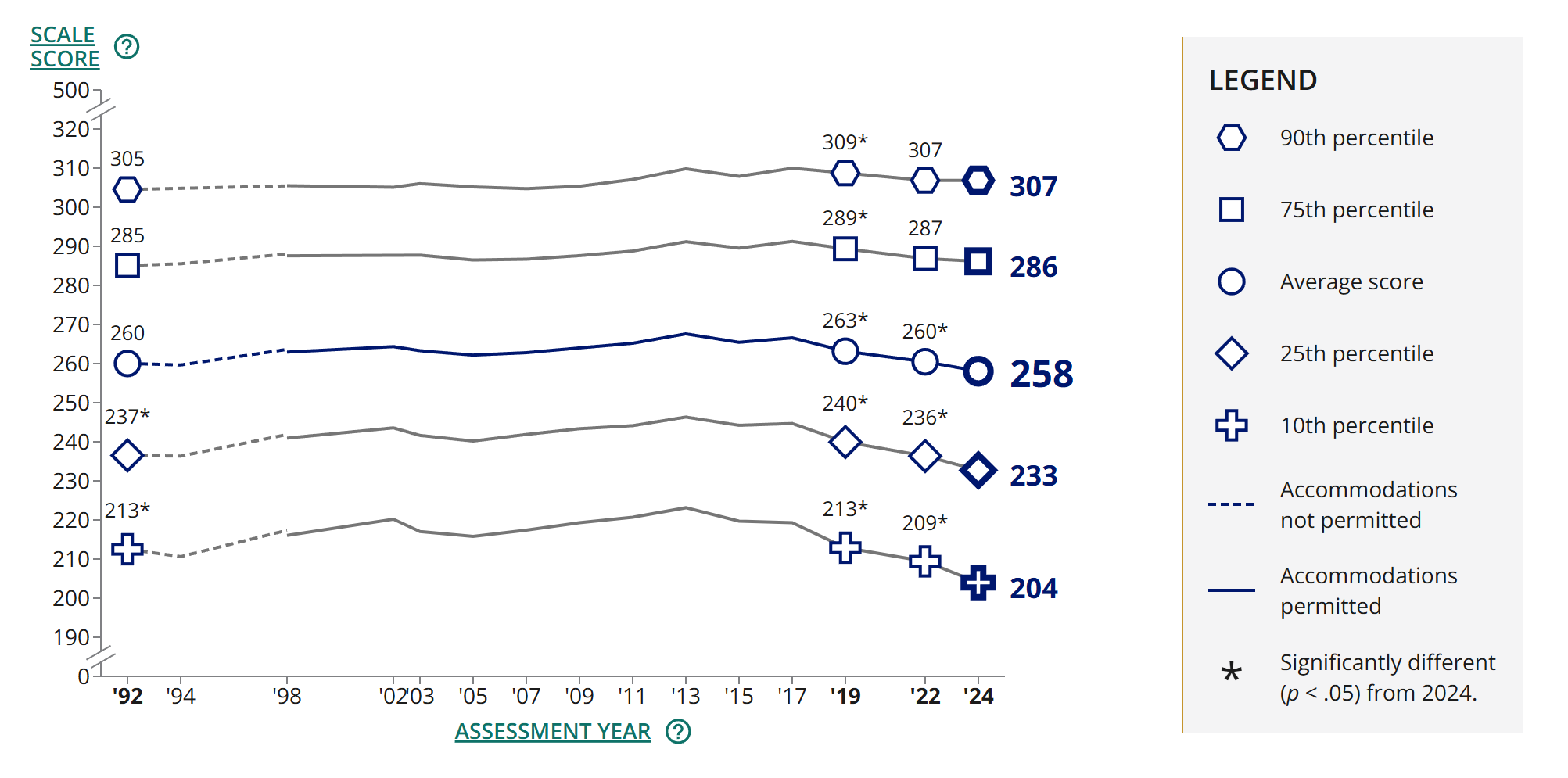
NAEP graph with reading scores from 1992 to 2024
These statistics align with the messages we see on social media, that students are struggling to read and follow basic assignment instructions. With this information, we can concretely define the literacy crisis as loss of the fundamental skills of reading and writing as shown by student’s consistently decreasing reading scores.
Works Cited
“NAEP Reading: Reading Results.” Nationsreportcard.gov, 2022, www.nationsreportcard.gov/reports/reading/2024/g4_8/?grade=8.
Williams, Christina. “America’s Literacy Crisis.” The Oracle, 2026, archeroracle.org/140741/features/americas-literacy-crisis/.